
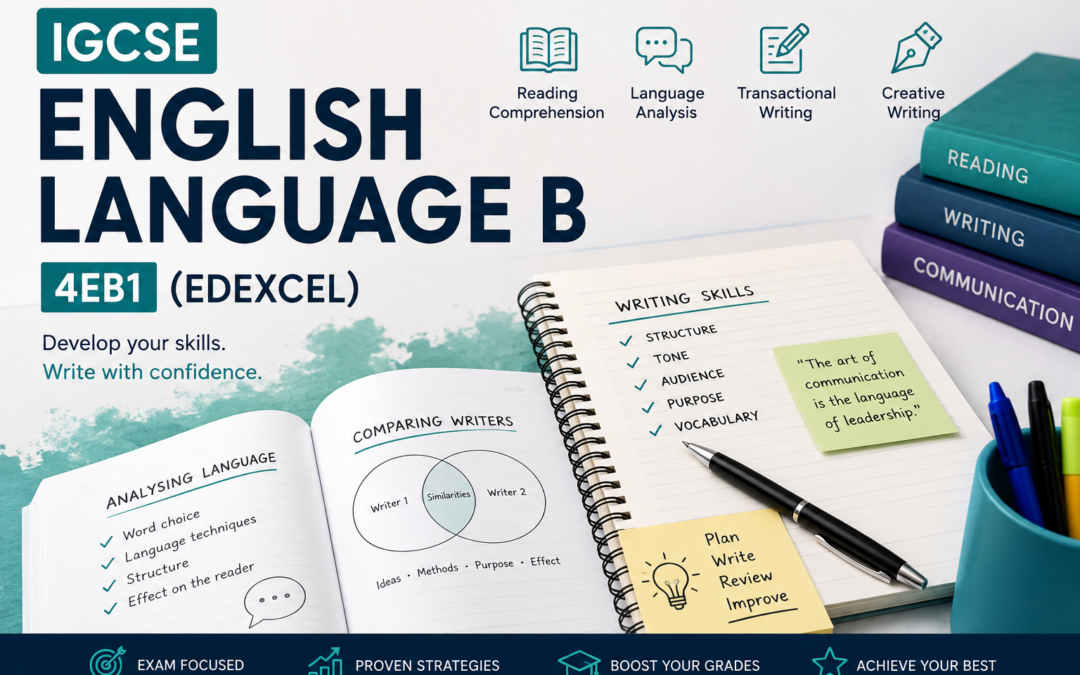
Prepare for success in IGCSE English Language B 4EB1 Edexcel with a focused, exam-style course designed to improve reading, writing, analysis and exam technique. This course helps students understand how to approach comprehension questions, language analysis, comparison tasks, transactional writing and creative writing with greater confidence. Through clear frameworks, model answers and examiner-style guidance, students learn how to structure stronger responses and avoid common mistakes that can limit marks.

This Edexcel IGCSE English Language B course is ideal for students who want to improve their grade, develop more accurate written expression and write with clear purpose, tone and control. Students will practise key skills such as selecting relevant evidence, explaining writer’s methods, comparing ideas, adapting writing for audience and using ambitious vocabulary effectively. By the end of the course, learners should feel more confident tackling the 4EB1 exam and producing responses that are clear, developed and exam-focused.
1 Foundation retrieval skills

***** 1.1 Precise retrieval for short-answer questions

1.1.1 Locating the exact answer

1.1.1 Locating the exact answer (Out)

1.1.2 Lifting carefully

1.1.2 Lifting carefully (Out)

1.1.3 Avoiding weak retrieval habits

1.1.3 Avoiding weak retrieval habits (out)

2. Single-text analysis skills

***** 2.1 Building an analytical paragraph

2.1.1 Paragraph argument

2.1.1 Paragraph argument (out)

2.1.2 Selecting evidence

2.1.2 Selecting evidence (out)

2.1.3 Explaining word choice

2.1.3 Explaining word choice (out)

2.1.4 Developing deeper interpretation

2.1.4 Developing deeper interpretation (out)

***** 2.2 Language methods

2.2.1 Vocabulary and connotation

2.2.1 Vocabulary and connotation (out)

2.2.2 Imagery and figurative language

2.2.2 Imagery and figurative language (done)

2.2.3 Tone and voice

2.2.3 Tone and voice (out)

***** 2.3 Structure methods

2.3.1 Openings and introductions

2.3.1 Openings and introductions (out)

2.3.2 Shifts and development

2.3.2 Shifts and development (out)

2.3.3 Sentence structure and repetition

2.3.3 Sentence structure and repetition (out)

***** 2.4 Overall effect and zoom-out sentences

2.4.1 Connecting to theme and message

2.4.1 Connecting to theme and message (out)

2.4.2 Avoiding capped analysis

2.4.2 Avoiding capped analysis (out)

3 Comparison skills

***** 3.1 Understanding comparison

3.1.1 Comparison mindset

3.1.1 Comparison mindset (out)

3.1.2 Comparison openings

3.1.2 Comparison openings (out)

3.1.3 Balanced coverage

3.1.3 Balanced coverage (out)

***** 3.2 Comparative paragraph structure

3.2.1 Text One evidence and analysis

3.2.1 Text One evidence and analysis (out)

3.2.2 Transition to Text Two

3.2.2 Transition to Text Two (out)

3.2.3 Text Two analysis

3.2.3 Text Two analysis (out)

3.2.4 Comparative zoom-out

3.2.4 Comparative zoom-out (out)

***** 3.3 Common comparison mistakes

3.3.1 Avoiding separate essays

3.3.1 Avoiding separate essays (out)

3.3.2 Avoiding vague comparison

3.3.2 Avoiding vague comparison (out)

4 Transactional writing skills

***** 4.1 Purpose, audience and form

4.1.1 Understanding the task

4.1.1 Understanding the task (out)

4.1.2 Controlling tone and register

4.1.2 Controlling tone and register (out)

4.1.3 Using source ideas

4.1.3 Using source ideas (out)

***** 4.2 Transactional paragraph development

4.2.1 Strong openings

4.2.1 Strong openings (out)

4.2.2 Main benefit paragraph

4.2.2 Main benefit paragraph (out)

4.2.3 Second benefit paragraph

4.2.3 Second benefit paragraph (out)

4.2.4 Challenges and counterarguments

4.2.4 Challenges and counterarguments (out)

4.2.5 Conclusions

4.2.5 Conclusions (out)

***** 4.3 Rhetorical and stylistic control

4.3.1 Persuasive phrases

4.3.1 Persuasive phrases (out)

4.3.2 Sentence variety

4.3.2 Sentence variety (out)

4.3.3 Connectives and cohesion

4.3.3 Connectives and cohesion (out)

5 Creative, narrative and descriptive writing skills

***** 5.1 Narrative writing

5.1.1 Narrative planning

5.1.1 Narrative planning (out)

5.1.2 Openings and hooks

5.1.2 Openings and hooks (out)

5.1.3 Building tension

5.1.3 Building tension (out)

5.1.4 Endings

5.1.4 Endings (out)

***** 5.2 Descriptive writing

5.2.1 Choosing a focus

5.2.1 Choosing a focus (out)

5.2.2 Sensory detail

5.2.2 Sensory detail (out)

5.2.3 Structural movement in description

5.2.3 Structural movement in description (out)

***** 5.3 Discursive writing

5.3.1 Building a balanced discussion

5.3.1 Building a balanced discussion (out)

5.3.2 Argument development

5.3.2 Argument development (out)

6 Exam performance and answer improvement

***** 6.1 Planning and timing

6.1.1 Reading questions carefully

6.1.1 Reading questions carefully (out)

6.1.2 Planning longer answers

6.1.2 Planning longer answers (out)

***** 6.2 Upgrading responses

6.2.1 Upgrading analysis

6.2.1 Upgrading analysis (out)

6.2.2 Upgrading comparison

6.2.2 Upgrading comparison (out)

6.2.3 Upgrading writing

6.2.3 Upgrading writing (out)

0 Average Rating
Choose Which Reviews You Want to See:
5 Stars 0% (0)
4 Stars 0% (0)
3 Stars 0% (0)
2 Stars 0% (0)
1 Stars 0% (0)

All Reviews

(0)
Course Includes:
1 Enrolled Student
6 Sections
65 Lessons
49 Quizzes
Intermediate level
Average Rating
0
Based on (0) reviews